The crawl that thinks like a generative engine.
Not just another spider. A JS-rendering crawler that respects robots, follows canonicals and records every status code, redirect and internal link — exactly what a ChatGPT or Perplexity bot does when deciding whether to cite you.
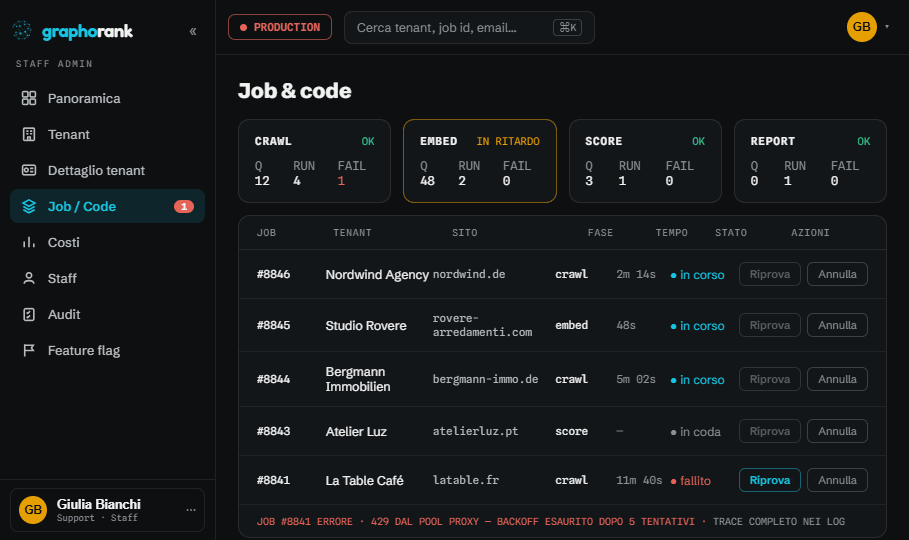
If the generative crawler gets lost in redirects and unrendered JavaScript, you don't exist in the answer. We show you exactly where it gets lost.
What it captures, page by page
Real rendering
We execute JavaScript like a browser does: we see the page the engine actually sees, not the raw HTML.
Link graph
Every internal link the crawler follows becomes an edge in the graph: depth, canonicals, redirects.
Quota respected
The crawler follows your plan and the robots rules. The free audit covers the first 10 pages.
What an AI agent actually keeps from a page
An agent does not see your layout. It fetches the HTML, throws away everything that is not content, and answers from what is left. Here is this site’s own home page, counted — in the language you are reading it in.
3.1%of our home page is text an agent can read — 4.1 kB of 133 kB of HTML.
What it keeps
- Words of readable text
- 752
- Headings (H2, H3)
- 8
- Links it can follow from the text
- 13
- Structured-data types
- 5
Structured data found:AnswerFAQPageOrganizationQuestionWebSite
What it drops
- Menu and footer links
- 55
- Inline graphics
- 11
- Scripts
- 10
- Markup and styling
- 128.9 kB
Not waste — menus, graphics and scripts are what makes the page usable for a person. They are simply not what an agent answers from.
Counted on this site’s own home page at build time. Nothing here is an estimate: change the page, and these numbers change with it.
Kick off your first crawl
Give it a domain — in two minutes you'll see how an engine walks through it.